Tuesday, February 21, 2012

Q&A with Todd Bracher

Todd Bracher’s work is instantly recognizable (and highly desirable) due to its simple functioning lines, alluring materials, and stunning workmanship. He describes his philosophy in a way that’s as honest and thought-provoking as his designs: “Reduction is very important to me…how we can take away everything and just leave what we need behind. That reveals for us something new, something that’s genuine and truthful, that’s not trying to be anything but what it is.” A native New Yorker, he spent 10 years living and working abroad in Copenhagen, Milan, Paris, and London before moving his practice to Brooklyn in 2007. His depth and breadth of experience ranges from heading up Tom Dixon’s design studio, acting Professor of Design at l’ESAD in Reims France, and serving as Creative Director of the Scandinavian luxury brand Georg Jensen.

Here’s my Q&A with the thoughtful and talented Todd Bracher.

Job description: Strategic Designer.

Why do you do what you do? I love connecting business solutions with design so that the end result is not only for increased company revenue but also a higher level of experience for the consumer. A definite win / win.

How do you break through a creative block? When I am blocked for me this always means that I am lacking information... so immediately I take back to the research and comb through again to see what I can rediscover to help get the ball rolling again...

Education: Yes I have a masters in Interior design and in Furniture design, but for me my education was the 10 years I spent living in Europe, winning, losing, failing, succeeding...

Mentors: Charles Darwin and Hokusai.

World-saving mission: My wife and I are saving the white sharks from extinction!

Office chair: The Supporto (Frederick Scott).

Office Soundtrack:Ideally music I have never heard before. This is the best for me to work with.

Most useful tool: No doubt that would be the mind where 85% of my solutions are born developed and executed.

Favorite space: Dark, natural, quiet, purposeful.

Favorite design object: The Zani & Zani pieces by Enzo Mari.

Guilty Pleasure: Food I have never tasted before.

Underrated: Travel to somewhere I have never been.

Overrated: Travel to somewhere I have already been.

What did you learn the hard way? Design is difficult and you have to be up for the challenge.

Has your work ever gotten you into trouble? No.

If you could cross over into other profession… what would you do? Physicist or Anthropologist.

Dream project: A single engine airplane.

Where’s home? An oddly shaped map I have in my mind.


You can easily sit or recline in this sofa or daybed that is appropriately called Freud for Zanotta in 2002.

Vas Glass Carafe for Italesse inspired by a pelican’s neck.


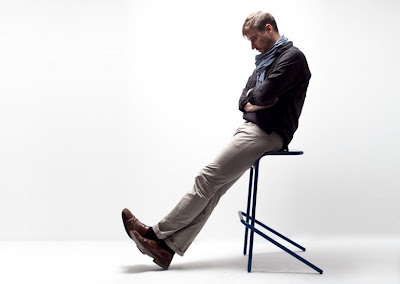
Stackable steel Alodia stool for Cappellini became available in 2010.


Simple and elegant steel and silicone kitchen utensils (2009) for Eva Trio.

The sculptural Stick Lamps (2009) made with metal tubing and Led lights were inspired by stick insects and deep-sea angler fish.

The Canard table system designed for Horm (2011) is simple and flexible. The four independent metal legs support a variety of structural surfaces and finishes.

T-no1 for Fritz Hansen (2007) is minimal in it's approach. “A surface for function, ribs to support the surface, a spine to hold the ribs and legs to bring the construction off the floor. Nothing more, nothing less” says Todd.


Black Dome lamp for Mater (2007) inspired by how light emanates in a 360 degree pattern. The Dome is made out of spun aluminum by one of the few remaining workshops in Denmark that has master the technique to perfection.

Bracher’s Trea chair (2011) finds inspiration from the movements of an exoskeleton which brings support and comfort to the sitter in both upright and reclined positions.

Link to Todd’s site

Sunday, February 19, 2012

Friday, January 27, 2012

Q&A with Leslie Williamson

What attracts me most to Leslie Williamson’s photography is the admiration and curiosity for her subjects captured in her work. She is well-known for her book Handcrafted Modern, a personal project that emerged from her passion for art and design. The concept is elegant in its simplicity: she photographs the homes of her favorite mid-century design heroes.

The book visits the dwellings of luminaries such as studio furniture makers Wharton Esherick, George Nakashima, and J.B. Blunk; industrial designers Eva Zeisel, Russel Wright, Jens Risom, Charles and Ray Eames; and even legendary architects Albert Frey and Walter Gropius. We get to peek into how these iconoclasts lived, helping broaden the definition of modernism. Leslie’s photograph of a red dress hanging in Walter Gropius’ house reveals a warm glow within the strong lines. We have Leslie to thank for giving us another perspective, and a new way to understand modernism.

Walter Gropius House from Handcrafted Modern

Professionally I have had the fortunate opportunity to work with Leslie on an article about Kay Sekimachi for American Craft magazine. Leslie’s photograph—a stunning still life showcasing Sekimachi’s jewelry that was made from shells and bones washed up by the sea—landed on the cover, and I couldn’t have been happier. It was my last issue as creative director and it was great to end on such a high note.


Without further ado, here’s my Q&A with Leslie.

Job description: Photographer, Writer, Blogger, Observer of the designed world, Wildly curious person. Best known for my book Handcrafted Modern: At Home with MidCentury Designers which started as a personal project of shooting my favorite design legends homes as they lived in them.

Why do you do what you do? Taking photographs has been the foremost way I figure out the world for over half my life, so at this point it doesn’t seem like there is a “why” in it. I couldn’t stop myself if I tried. I am very fortunate that I get to do what I love most for a living. In the last 5 years, through working on Handcrafted Modern and then moving on to my new projects and continuing to shoot more and more of my own ideas for others I have found an added joy in being able to talk and write about these places I shoot. It seems the marrying of my stories and images has added a deeper joy in what I do.

How do you break through a creative block? As a photographer, I don’t really have that problem very often (knock on wood). Ideas flow and I have gotten to the point where I know to trust my gut. On occasion I might get sidetracked somehow, but I catch myself pretty quickly. Sometimes my ideas are like a runaway train…I just hold on and go for it!

With writing it is a completely different thing. Writing is relatively new for me so my process is not as worked out. I have found that I need space around writing. I cannot shoot in the morning and write in the afternoon. So the most challenging “block” is finding the time and space to get to the mental space I need to be in. If I have trouble in the midst of writing I usually stop and dance a bit…lately to early Elvis Costello for some reason…Or I just go for a walk near some water—get away from the whole thing for a spell.

Education: Art Center College of Design, Pasadena, CA and Life…the best education of all if you pay attention!

Mentors: Paul Ender (my high school design teacher), Bill Stout (when I was working on my book he was really helpful and his bookstore is a haven for me. stoutbooks.com), Dung Ngo (my editor at Rizzoli, he is great at pushing me)…there are more I’m sure. Sometimes just one sentence from someone or a really good conversation can really push me to a new place with my work, thinking, etc.

Office chair: Most often it is the drivers seat of my old trusty RAV 4 or the rental car I happen to be driving. At my studio, an old Eames soft pad chair. It is from the late 70’s or early 80s and has the really great old leather, not like the ones now…I love that thing…

Office Soundtrack: This is SUCH an important question! Music is a key part of my life, since a lot of my time is traveling to and from places alone. Music is my travel companion and friend a lot of the time. And I also use music to manage my mood. So I have mixes for every possible mood and place—mixes for printing in the darkroom, for when I wake up, I even have a “happy” mix for when I am grouchy. And then there are the “Solid Gold” mixes which I do for myself but are rather popular with my friends. Lots of classic rock from all eras. It is a guaranteed dance party.

Download my “Happy” mix list.

Most useful tool: My eyes, heart, intuition, and imagination and of course a camera comes in very handy…preferably a Mamiya RZ67 and some film but I shoot with a PhaseOne 645 and Canon 5D as well.

Favorite space: Because I shoot spaces all the time I am constantly getting “crushes” on different places. I crush A LOT!

But my favorite spaces are ones that I get to spend more time in, that I repeatedly go back to. I love JB Blunk’s house for that reason (and many others). I originally shot it for Handcrafted Modern, but have continued to return and photograph all the artists at the artist residency there. So I have been back numerous times. Plus JB’s daughter, Mariah, is now a dear friend, so I go up and spend the afternoon and we weed the garden and make dinner. I just feel at home there and I love noticing all the little changes that occur in the house. It is a living, breathing thing.

The most sacred space for me is one that doesn’t exist anymore. My Grandmother’s house. Before we sold it (and it was subsequently torn down) I photographed it. That place is stitched into my soul. I can still hear the sound of the back door shutting in my head and it has been gone for quite awhile now. Someday that project will be a book.


What an extraordinary soft color palette Leslie found in her Grandmother's undergarment drawer.


Favorite design object: I have these two rocks that are covered in leather by a japanese artist (wish I had his name!). I love those two things so much…they are in the dish where I put my keys everyday.


Guilty Pleasure: I have none… I mean really…if it is a pleasure I think it should be embraced! Why feel guilty? Taylor Swift, Hallmark movies, little old men with dark socks and sandals? No guilt. Love them with abandon!


Underrated: Modesty—in people, in objects, in places…


Overrated: Bleu Cheese


What did you learn the hard way? To trust myself and my gut implicitly. A lot of detours taken to get to that all important one…but they were fun. or calamitous. or both.


Dream project: Just about to embark on that in the spring. I am photographing all the European Homes for Handcrafted Modern Europe as well as folding in all the European craftspeople for my project on the evolution of different craftsmen. Plus I am starting a new project as well…top secret! I cannot wait!!!


Where’s home? Home is where my heart is, so I feel most at home in San Francisco and New York where most of my dearest friends and family are. But if I am with someone I love—even if I just met them—I am home.


Wharton Esherick home & studio landed on the cover for Handcrafted Modern


JB Blunk’s House is one of Leslie’s favorite places that she continuously photographs at different times of the year.
The house was included in her book Handcrafted Modern.


Photographs from artist Jesse Schlesinger’s built environment installation in San Francisco.


Furniture designer Paul Loebach is a recent subject for Leslie’s current project about craftsmen.

Here’s a link to Leslie’s website.

Wednesday, December 14, 2011

Q&A with Tini Bloom


Tini Bloom’s eccentric jewelry first caught my eye a few years ago at Bird, the Brooklyn clothing boutique. It’s stuck with me ever since. Her company moniker is Etten Eller, which means “either - or”, inspired by the Danish philosopher Søren Kierkegaard’s book Enten‒Eller. I read on a NBC blog that she intentionally changed the spelling. I especially adore that each piece is titled with a significant date and event, such as 08.27.1965: Le Corbusier dies while swimming in the Mediterranean off Cap Martin, or 02.18.1979: Snow falls in the Sahara desert. In this way, her jewelry becomes more than an object, it is a story or a memory. Visually her collections are delicate, yet strong and well crafted. Her exhaustive exploration in a scheme of metal discs, beads, and chains yields unending possibilities season after season.

I’m happy to kick off Rational Beauty’s Q&A series with Tini Bloom.

02.01.1884
The day the Oxford Dictionary debuted.

01.12.1963

The day Sam Cooke records Live at the Harlem Sq Night Club in Miami.


Job description: I design and produce a collection of jewelry.


Why do you do what you do? I think the motivation has changed and developed over time and continues to. My creative output however has always been a way for me to process the environment around me and the experiences I encounter. A visual diary of sorts. I ingest the world around me and digest it through my creative process and output. Its how I zero in on the details that interest me, the space in between, the moments that comprise my day and ultimately my life. I like to shed light upon the unexpectedly beautiful. To draw ones attention a little closer. Encourage one to slow down and move in a little closer to take notice and stock of the subtleties. With the jewelry I try to catch ones attention graphically and formally, intrigue one enough to make them stop and take notice and then once they come in a little closer they notice all these subtle details to the pieces.


How do you break through a creative block? Leaving the studio. Stimulating myself in the world and enjoying myself outside of the studio is probably the most helpful thing. Taking a break really. Doing something completely different. Feeding and informing myself in another way always proves to be the most beneficial to re-inspire me.

Education: I went to the School of the Art Institute in Chicago. While I knew I was attending a highly conceptual art school, heavy on theory, I was interested myself in developing skills to apply towards design for fashion, at the time it was textiles. The school had no core curriculum which allowed me to dip between departments developing, for example, color in the painting department, line in the print department, traditional textile practices in the fiber department, etc. All the while I was surrounded by interesting dialogues about art, which informed the way I viewed everything around me and ultimately developed my designs. I found this more important than just learning a straight skill.

Mentors: I find a mentor in pretty much everyone I encounter. Everyone has something of value to share and teach. I enjoy most about this work the opportunity to collaborate with different craftsmen and engineers.


What did you learn the hard way? Everything feels hard when you are unfamiliar with it, but then you learn and absorb it into your wealth of knowledge and each time the difficulties get a little easier because you understand it is the natural rhythm of the unknown. Learning is hard, but completely rewarding.


Most useful tool: My own two thumbs.


Favorite space: A large body of water. I like to be fully submerged with a open horizon line and expansive sky


Favorite design object: I don’t know if I would say favorite, but I think Apple does the most beautiful job with all their packaging.


Guilty Pleasure: Internet TV


Underrated: Living without the internet, I read a hell of a lot more when I chose to live without it for a year.


Overratted: The internet, too much information if you ask me. I often don’t even know where to go when i sit before a computer online. i prefer the more old fashion forms of discovery.


Dream project: To spend a year traveling and absorbing the world around me in various different places.


Where’s home? I’m not sure at present. I suppose wherever I am.


11.08.1895
German scientist discovers X-rays.


02.18.1979

Snow falls in the Sahara desert.


01.11.1813

The first pineapple is planted in Hawaii.


For more information: etten eller

Monday, August 1, 2011

Unravel: Knitwear in Fashion

Tilda Swinton wearing four Sandra Backlund silhouettes photographed for
Another Magazine by Craig McDean.

It’s pretty simple—right? Drop one, pick up two, drop one. In knittings most basic form all you need is a pair of needles and a ball of yarn. Think again. Early summer I had the opportunity to see the “Unravel” exhibition at MOMU—Fashion Museum Province of Antwerp. The show helps re-brand knitting from old fashion to “uber-cool”.

Kaat Debo, director of MOMU, states in the show catalogue—“This exhibition does not intend to sketch an exhaustive history of knitwear, but aims to look beyond the stuffy image that may seem to attribute to it.” The exhibit has been curated by Karen Van Godtsenhoven (MOMU) and Emmanuelle Dirix (Winchester School of Art, Southhampton Universtiy and the Fashion Department of the Royal Academy of Antwerp. The examples presented range from ready-to-wear to haute couture encompassing both hand and machine knitted from established names to young emerging designers.

The highlight for me were the designers who hand-knitted the garments. The pieces show innovation with a bespoke stamp. The garments appear to emerge from knitting rather than patterns. I particularly feel this way about the work by Swedish Sandra Backlund. (top picture)

For those who would like to learn more, the exhibition catalogue by Emmanuelle Dirix takes a look at the history, production methods, social histories and the aesthetic (r)evolutions of knitwear in fashion.

After leaving the exhibit I wanted to pick up my needles, gets some yarn and start a project. Once the summer heat dies down I’m definitely going to make the Margiela military sock sweater since he offers up the instruction in the true spirit of making.


A tribute to Ann Salens’s multi-colored silk dresses. (1970-1975)

Christian Wijnants created the tie-dye dress for the exhibition.
He is a teacher, specializing in knitwear, at the Royal Academy for Fine Arts in Antwerp.
His work has been inspired by Ann Salens (above). Photography: Viviane Sassen


1910 - 1930s knitted swimsuits ranging from wool, jersey and
cotton became an icon for the modern era.


Bathing Suit by Elsa Schiaparelli, circa 1928 © Condé Nast Archive / Corbis


Dirk van Saene’s Petite and Heidi, two woolen jumpers with
knit trompe l’oeil motives. (2008-2009)


John Car Doughtly, 1966 © London College of Fashion


Woolen sweater made from military socks, Maison Martin Margiela, 1991-1992.
Photo Jacques Sonck

Martin Margiela instructions on how to make your very own woolen sweater from socks
published in A Magazine ( June 2004 ) curated by Maison Martin Margiela.


Installation “The Supermarket of Style” designed by Angelo Figus, art director and trend forecaster at Pitti Filati/Pitti Immagine, Florence. Originally the installation appeared in 2006 for the Italian Fashion fair Pitti Imaagine to predict fashion trends. He created a world that is all knitted ranging from status symbols like the fashion bags, Rietveld chair to groceries and washing machines. In 2006 ironically enough a real knitted Vuitton bag appeared. As stated in the catalogue that Figus chose knitwear because “it is an art, but also a science, almost like algebra, that gives rise to new formulas that lead to new results.”


Mind-boggling handknitted pieces from various designers from Yohji Yamamoto to
Sandra Backlund. My personal favorite of the exhibition.


Included in the exhibition was fashionable and historical hosiery.
Above shows hoisery by Bernhard Wilhelm from his women’s collection from 2007.
Photo by Carmen Freudenthal. Styled by Elle Verhagen


Knitted fishnet stockings by Jurgi Persoons, 1999. Photo by Ronald Stoops